
Technology changes the task, but our professional value must evolve with it.
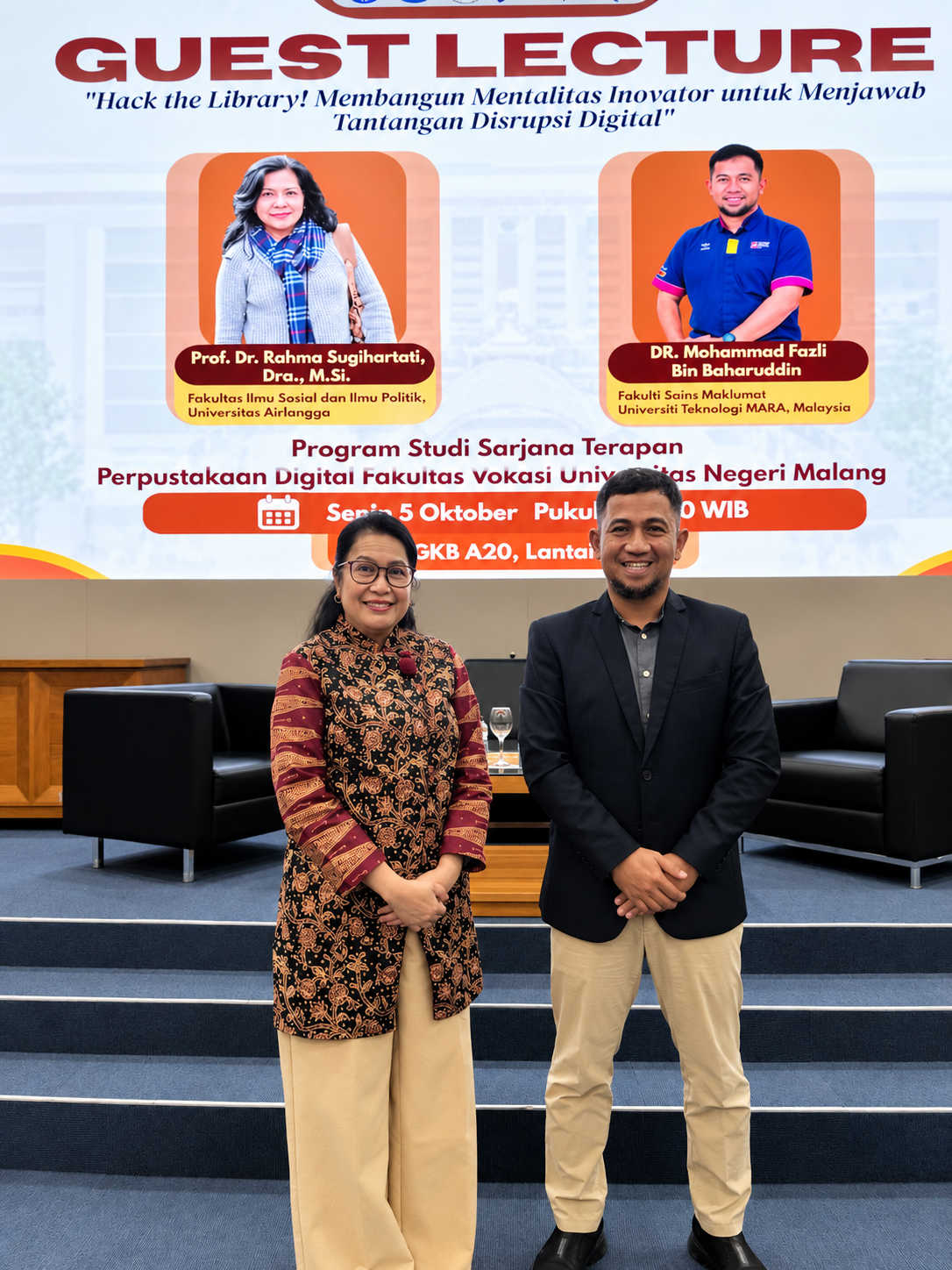
On October 5, 2026, I had the distinct honor of being invited by Universitas Negeri Malang (UM), Indonesia, to deliver a Guest Lecture to an incredibly engaged audience of students, academics, and information professionals. It was a fantastic opportunity to discuss a topic that is deeply personal to my work and critical to our field: the survival and evolution of libraries in the age of Artificial Intelligence.
It was also an absolute privilege to share this platform with the esteemed Prof. Rahma Sugihartati from Universitas Airlangga (UNAIR). Sharing insights across borders, from Malaysia to Indonesia, reminded me that while our institutions may differ, the digital disruptions we face in the information science sector are universal.
Rethinking the Library's Value Proposition
During my session, titled "Building Adaptive and Innovative Mindsets in the Modern Library: Strategies to Master Digital Disruption," I posed a challenging scenario to the audience:
Imagine it is the year 2035. If information is instant, intelligent, and available everywhere through AI assistants, what makes the library worth choosing?
For 500 years, the library's primary value proposition was overcoming information scarcity. We were the custodians of physical collections. Today, we are facing the exact opposite problem: information abundance and synthetic generation.
I emphasized to the attendees that the future threat is not that information will disappear from libraries. The real threat is that users might no longer see a reason to start their research journey with us. To counter this, we need to shift our mindset from defensive preservation to proactive value creation.
From Access to Trust
A key takeaway from our discussion was how the core function of the librarian is shifting. When search engines evolve into "answer engines" (like ChatGPT and other generative AIs), the interface often hides the original sources.
Therefore, the modern library must transition:
Yesterday: Access to information.
Today: Access + Discovery + Support.
Tomorrow: Trust + Context + Verification + Learning.
A Collaborative Future
Listening to the perspectives shared during the event, especially alongside Prof. Rahma's invaluable insights, reinforced my belief that the future of librarianship is bright, provided we are willing to adapt. Adaptation is an ongoing organizational discipline, not a one-off initiative. We must continuously Sense, Learn, Adjust, and Repeat.
I want to extend my deepest gratitude to Universitas Negeri Malang for their warm hospitality and for organizing such a forward-thinking event. To the students and fellow professionals who attended: your thoughtful questions give me great hope for the next generation of digital librarians.
The question is no longer "Will libraries exist?" but rather, "What value will we create to make them absolutely necessary?"
Let's keep building that future together.